
Weekly Highlights
 Saint Thomas33°C91°F Jun 14Coolest
 Dominica(tied with Saint Croix)23°C73°F Jun 9Windiest
 Barbados48 km/h30 mph Jun 13Wettest Dominica27.2 mm1.07 in (Jun 11, 8.9 mm0.35 in)Driest Saint Croix(tied with
  Sint Eustatius)0 mm0 in
Based on data collected across 18 Eastern Caribbean islands over the past 7 days.
This Week in the Eastern Caribbean
The Eastern Caribbean is experiencing typical early-season conditions as June progresses deeper into the Atlantic hurricane season. Regional temperatures have ranged from 23°C73°F in the mountainous interior of larger islands to 33°C92°F in exposed coastal areas. Humidity levels have remained elevated at around 81%, typical for this time of year as trade wind patterns settle into their seasonal rhythm.
Over the past seven days, scattered clouds and brief passing showers have been the norm across the region, with Dominica recording the most rainfall at 27.2 mm1.07 in while some islands, notably Saint Croix, experienced no measurable precipitation. Winds have generally been moderate, with peak gusts around 48 km/h30 mph reported in Barbados. Sea conditions have remained manageable, with waves averaging between 1.2 to 2.1 metres4 to 7 feet.
This Week's Outlook
The immediate forecast shows persistent tropical wave activity moving through the region, but atmospheric moisture levels remain too low to support significant development or heavy rainfall. The Antigua Meteorological Office expects partly cloudy skies with occasional brief passing showers through the coming days, particularly around tropical wave passages. Winds will continue from the east, maintaining the classic trade wind pattern that characterizes June in the Caribbean.
Sea conditions are expected to gradually build through midweek, potentially reaching 1.8 to 2.4 metres6 to 8 feet in the swell as a high-pressure system repositions itself east of 60°W. Conditions remain favorable for normal marine and coastal activities, though mariners should monitor gradually increasing seas as the week progresses.
Tropical Activity and Atlantic Basin Conditions
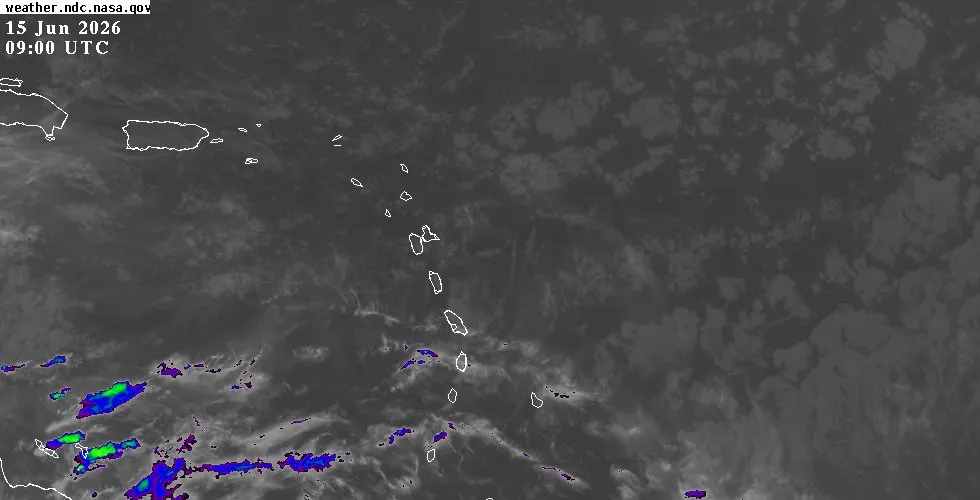
The National Hurricane Center is currently tracking four separate tropical waves in the Atlantic basin, though none poses immediate threat to the Eastern Caribbean or broader Atlantic. The most significant system for the region is the eastern Caribbean tropical wave positioned along 67°W south of 18°N, moving westward at 24 to 32 km/h15 to 20 mph. This is the system responsible for the scattered convection and occasional showers noted in regional forecasts.
Three additional tropical waves remain well to the east, with the furthest positioned along 19°W and others at 33°W and 50°W, all moving westward at typical velocities for early hurricane season. An expansive subtropical high-pressure system continues to dominate the tropical Atlantic, supporting fresh to locally strong easterly trade winds and seas of 2.4 to 2.4 metres8 feet across key maritime zones. The high-pressure pattern will remain largely in place through the week, maintaining the settled conditions that define the current period.
For the complete National Hurricane Center tropical weather outlook, satellite imagery, and detailed forecast graphics, visit the outlook page.
The region remains in an active wave period, which is expected as the Atlantic basin transitions deeper into peak hurricane season. However, current atmospheric conditions including wind shear patterns and limited moisture support a quiet period for organized tropical cyclone development. Residents and visitors should remain vigilant about typical early-season activity while understanding that the present atmospheric setup continues to favor scattered shower activity rather than significant weather systems.
For detailed island-by-island conditions, check the weather page. To view live radar and satellite imagery, consult the interactive map.