


GOES-19 IR Caribbean. Image courtesy of NOAA. Image updated: 2026-08-29 8:51 PM AST.
Eastern Caribbean Forecast
Updated: 2026-08-29 02:06 AST 19 hours ago
Across most of the eastern Caribbean, as a strong tropical wave (the remnants of Dolly) approaches the area, we can expect increased cloudiness later today into tonight and tomorrow with periods of moderate to heavy showers along with windespread thunderstorms and strong gusty winds over and around these islands periodically during the next 24 hours and beyond.
Winds: East-northeast
Seas: 1.2 to 2.4 metres or 4 to 8 feet.
Forecaster: Bernell Simon — A daily forecast issued by the Antigua & Barbuda Met Office, covering the Eastern Caribbean islands.
NHC Eastern Caribbean Outlook
Updated: 2026-08-29 7:35 PM AST 1 hr ago
Tropical Wave AL97TW 150 mi east of Antigua and Barbuda See how close it is to the Eastern Caribbean Islands.See how close it is to your island. Open the live map ›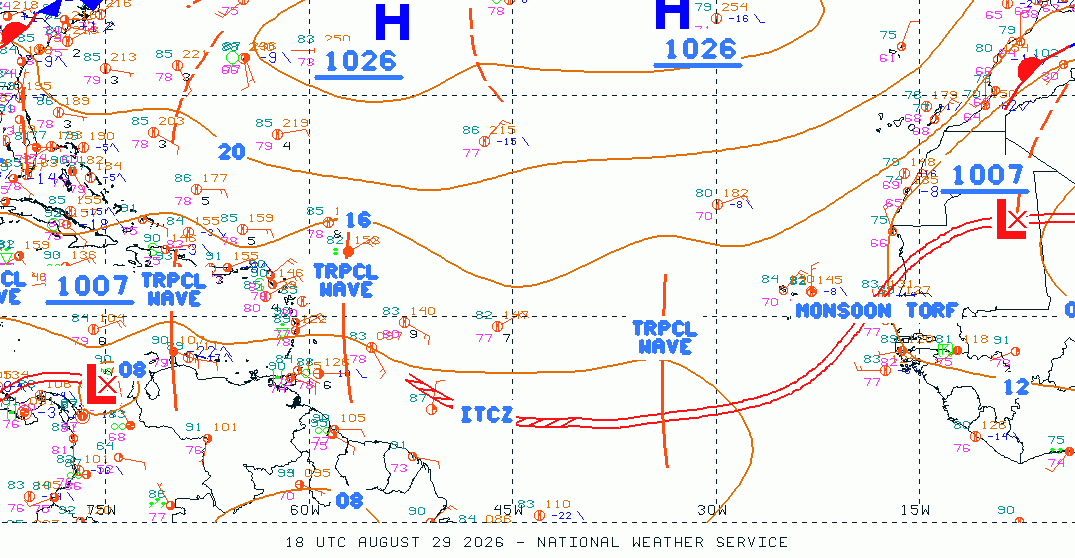
Significant Rainfall: Disorganized showers and thunderstorm continue in association with the remnants of Tropical Storm Dolly, located about 300 miles east of the Leeward Islands. However, there are no signs that the system is developing a closed circulation. Redevelopment of this system is unlikely while it moves westward to west-northwestward near 25 mph.
The wave could bring locally heavy rains and gusty winds to portions of the Leeward Islands, the Virgin Islands and Puerto Rico over the next several days. The main hazards for Puerto Rico will be urban flooding, lightning, and gusty winds, especially tonight into Monday. The potential for isolated flash flooding is lower but cannot be ruled out.
Rainfall amounts and the location of the highest totals remain uncertain. Islands local topography could enhance orographic lift and support additional rainfall, varying by island. Peak rainfall rates are expected from tonight through Sun.
A tropical wave is along 34W, south of 18N, moving westward at around 15 kt. No significant convection is noted near this wave.
A tropical wave is along 58W, south of 21N, moving westward around 20 kt. A 1009 mb low pressure, remnants of T.S. Dolly, is along the wave axis near 17N58W.
A cluster of moderate to isolated strong convection is within about 90 nm NW quadrant of low center. Fresh to strong winds and rough to very rough seas are noted on either side of the wave axis per scatterometer and altimeter data, covering roughly the waters from 16N to 22N between 50W and 60W.
From the NHC Tropical Weather Discussion, issued four times a day. The NHC labels each release with a scheduled cycle time (8:15 PM AST here), while the timestamp above shows when we received it. Based on satellite imagery through 7:00 PM AST.
— Forecaster: GR
Tap any image to enlarge


Image courtesy of NOAA. Updated at approximately 2 AM, 8 AM, 2 PM, and 8 PM EDT from 15 May to 30 November, with special outlooks issued at any time as conditions warrant. The graphic displays all currently active tropical cyclones, and disturbances with tropical cyclone formation potential over the next five days.
Updated: 2026-08-29 8:00 PM AST 1 hour ago
East of the Leeward Islands (Remnants of Dolly): Showers and thunderstorm continue in association with the remnants of Tropical Storm Dolly, located about 150 miles east of the Leeward Islands. However, there are no signs that the system is developing a closed circulation. Redevelopment of this system is unlikely while it moves westward to west-northwestward near 25 mph. The wave could bring locally heavy rains and gusty winds to portions of the Leeward Islands, the Virgin Islands and Puerto Rico over the next several days.
* Formation chance through 48 hours...low...near 0 percent.
* Formation chance through 7 days...low...10 percent.
Atlantic storm names for 2026
- Arthur AR-thur
- Bertha BUR-thuh
- Cristobal krees-TOH-bahl
- Dolly DAH-lee
- Edouard eh-DWARD
- Fay fay
- Gonzalo gohn-SAH-loh
- Hanna HAN-uh
- Isaias ees-ah-EE-ahs
- Josephine JOH-seh-feen
- Kyle KY-ull
- Leah LEE-ah
- Marco MAR-koe
- Nana NA-na
- Omar OH-mar
- Paulette pawl-LET
- Rene re-NAY
- Sally SAL-ee
- Teddy TEHD-ee
- Vicky VIH-kee
- Wilfred WILL-fred
Regional Satellite Animations
Updated: 2026-08-29 9:15 PM AST 3 min ago
These satellite animations cover the Eastern Caribbean and the full tropical Atlantic from the West African coast to the Caribbean Sea. Each animation starts as a still image. Click play to start.
GOES East Infrared – Caribbean
An enhanced infrared satellite animation from GOES East (Band 13, 10.3 µm) focused on the Eastern Caribbean. Infrared imagery detects heat radiating from cloud tops — the colder (and therefore higher) a cloud top, the more likely it is producing heavy rain or thunderstorms. Bright blue-green and white areas indicate very cold, tall cloud tops associated with active convection, while grey tones show lower, warmer clouds or clear skies. This view is particularly useful at night when visible imagery is unavailable, and for spotting developing thunderstorm clusters that could organise into tropical disturbances.

Satellite animation courtesy of NASA/MSFC.
GOES East Infrared – Atlantic
A wider infrared satellite animation from GOES East (Band 13, 10.3 µm) covering the tropical Atlantic from the Eastern Caribbean to the West African coast. This zoomed-in view makes it easier to track individual cloud clusters and tropical waves as they cross the Atlantic — the classic path toward the Caribbean during hurricane season. The colour scale highlights cold, high cloud tops in blue-green and white (indicating deep convection and potential storm development), while warmer grey tones represent lower clouds or clear skies.

Satellite animation courtesy of NASA/MSFC.
GOES‑19 Caribbean – Geocolor
GeoColor imagery shows the Earth as it appears to the human eye during the day, with enhanced city lights and infrared cloud detection at night. This close-up view of the Caribbean basin highlights cloud formations, approaching weather systems, and the Saharan dust layer (visible as a hazy brownish tint over open water). Useful for seeing the overall state of weather around the Eastern Caribbean islands at a glance.

Satellite animation courtesy of NOAA.
GOES‑19 Tropical Atlantic – Geocolor
GeoColor imagery shows the Earth as it appears to the human eye during the day, with enhanced city lights and infrared cloud detection at night. This wide-angle view stretches from the West African coast to the Caribbean, making it ideal for tracking tropical waves as they move westward across the Atlantic — the classic path that can lead to tropical storm and hurricane development during the season. You can also observe large-scale cloud patterns, the Saharan dust layer (appears as a hazy brownish tint), and the overall state of the tropical Atlantic.

Satellite animation courtesy of NOAA.
The two "visible band" animations below only include frames captured during daylight hours. Nighttime frames appear dark and are excluded.
GOES East Visible – Leeward Islands
A high-resolution visible satellite animation from GOES East (Band 2, 0.64 µm) centred on the Leeward Islands. Visible imagery shows clouds as the human eye would see them from space — bright white areas are thick clouds likely producing showers, while thin wispy clouds appear grey. This band offers the sharpest detail of any GOES channel, making it excellent for tracking individual shower cells, sea breeze boundaries, and developing convective systems. Visible imagery is only available during daytime hours.

Satellite animation courtesy of NASA SPoRT/MSFC.
GOES East Visible – Windward Islands
A high-resolution visible satellite animation from GOES East (Band 2, 0.64 µm) centred on the Windward Islands. Same technology as above but framed to show the southern Eastern Caribbean, useful for monitoring approaching weather from the south and east, including interaction of tropical waves with the ITCZ (Inter-Tropical Convergence Zone). Only available during daytime.

Satellite animation courtesy of NASA SPoRT/MSFC.
Wind & Forecasts
Updated: 2026-08-29 7:45 PM AST 1 hour ago
The surface chart forecasts 24 hours ahead; the wind and wave charts cover the next 12 hours. Updated several times daily.
Winds are light to breezy across the Eastern Caribbean.
Readings updated: 2026-08-29 9:00 PM AST 19 min ago
- Saba 33 km/h20 mph
- Saint Barthélemy 30 km/h18 mph
- Sint Eustatius 29 km/h18 mph
- Anguilla 28 km/h17 mph
- Saint Martin 27 km/h17 mph
- Antigua and Barbuda 26 km/h16 mph
- Grenada 26 km/h16 mph
- Saint Kitts and Nevis 24 km/h15 mph
- Saint Thomas 24 km/h15 mph
- Montserrat 23 km/h14 mph
- Saint Croix 22 km/h14 mph
- Guadeloupe 20 km/h12 mph
- Barbados 19 km/h11 mph
- St Vincent 18 km/h11 mph
- British Virgin Islands 15 km/h9 mph
- Saint Lucia 9 km/h6 mph
- Dominica 9 km/h6 mph
- Martinique 4 km/h2 mph
Light to breezy (under 29 mph) Very breezy (29–33) Windy (34–38) Tropical storm (39–73) Hurricane (74+)
12-hour wind forecast
Shows predicted wind speeds across the Caribbean basin for the next 12 hours. The colour-filled regions use a rainbow scale — purple and blue shades represent lighter winds, greens and yellows indicate moderate winds, and orange to red areas signal the strongest winds. The colour bar along the top of the chart shows the wind speed values in knots. Use this chart to anticipate incoming wind changes, assess conditions for maritime travel, or gauge how a developing weather system may affect wind patterns in your area. Click the image to enlarge.

Image courtesy of NOAA.
Tropical Atlantic 12-hour wave height forecast
GFS-Wave significant wave height in metres (colour scale on the left) with 10-metre wind barbs, 12 hours from the issue time, across the tropical Atlantic from the Eastern Caribbean toward the West African coast. Cooler blues are calmer seas; greens, yellows and reds mark progressively higher waves. Useful for boating, fishing and coastal activities, and for tracking swells from distant storms. Click the image to enlarge.

Image courtesy of NOAA.
Tropical Atlantic 24-hour surface forecast
The forecast position of pressure systems (highs and lows), fronts, troughs, tropical waves (dashed lines tracking westward, often the seeds of tropical storms in season), the monsoon trough and the ITCZ, 24 hours from the issue time. Tightly packed isobars mean stronger winds. Click the image to enlarge.

Image courtesy of NOAA.
Rainfall Tracking
Satellite updated: 2026-08-29 2:00 PM AST 7 hours ago
Rainfall over the last 24 hours. Plus, 3-hour and 24-hour satellite precipitation maps.
Light rain across much of the Eastern Caribbean, heaviest over Dominica and Barbados.
Readings updated: 2026-08-29 9:00 PM AST 19 min ago
- Dominica Light 11 mm0.45 in
- Barbados Light 6.7 mm0.26 in
- Guadeloupe Light 3.9 mm0.15 in
- Saint Lucia Light 3.4 mm0.13 in
- Martinique Light 3.1 mm0.12 in
- Montserrat Light 2.7 mm0.11 in
- Antigua and Barbuda Light 2.2 mm0.09 in
- Grenada Light 2.2 mm0.09 in
- Saint Kitts and Nevis Light 2.1 mm0.08 in
- St Vincent Light 1.8 mm0.07 in
- Saint Barthélemy Light 1.2 mm0.05 in
- Saba Light 1.1 mm0.04 in
- Anguilla Light 0.8 mm0.03 in
- British Virgin Islands Light 0.6 mm0.02 in
- Saint Thomas Light 0.4 mm0.02 in
- Saint Martin Light 0.3 mm0.01 in
- Saint Croix Light 0.2 mm0.01 in
- Sint Eustatius N/A no local data
Light under 25 mm, moderate 25–50, heavy 50–100, very heavy 100–200, flood 200+ mm.Light under 1 in, moderate 1–2, heavy 2–4, very heavy 4–8, flood 8+ in.
Satellite-derived rainfall for the Eastern Caribbean from NASA IMERG Early. Each map below opens as a still image showing the most recent total. Press play to step back through its history:
- 3-Hour Rainfall Totals: the still shows the latest 3-hour total. Press play to review the last 48 hours in 3-hour steps and watch the rain bands move across the islands.
- 24-Hour Rainfall Totals: the still shows the latest full-day total. Press play to review the last 7 days, one day at a time.
3-Hour Rainfall Totals (early) – Caribbean
3-hour rainfall totals from NASA IMERG Early, which runs about 4 hours behind real time — so this is the most recent view. Each frame is a 3-hour window covering the last 48 hours; press play to watch the rain bands move across the islands. Greens are lighter totals; yellow, orange and red mark progressively heavier rainfall (see the inch scale on the image).

Animation courtesy of NASA SPoRT.
24-Hour Rainfall Totals (early) – Caribbean
24-hour rainfall totals from NASA IMERG Early. Each frame is a full day; press play to step through the past week, one day at a time, for a longer-range picture of where the heaviest rain fell. Blues and greens are lighter totals; yellow, orange and red mark progressively heavier accumulations (see the inch scale on the image).

Animation courtesy of NASA SPoRT.
Saharan Dust
Updated: 2026-08-29 3:02 PM AST 6 hours ago
Dust is currently low across the Eastern Caribbean.
Readings updated: 2026-08-29 9:00 PM AST 19 min ago
- British Virgin Islands Low 2 µg/m³
- Saint Thomas Low 2 µg/m³
- Saint Croix Low 2 µg/m³
- Antigua and Barbuda Low 1 µg/m³
- Dominica Low 1 µg/m³
- Grenada Low 1 µg/m³
- Montserrat Low 1 µg/m³
- Saint Kitts and Nevis Low 1 µg/m³
- Anguilla Low 1 µg/m³
- Barbados Low 1 µg/m³
- Saint Martin Low 1 µg/m³
- Guadeloupe Low 1 µg/m³
- Martinique Low 1 µg/m³
- Sint Eustatius Low 1 µg/m³
- Saba Low 1 µg/m³
- Saint Barthélemy Low 1 µg/m³
- Saint Lucia Low 0 µg/m³
- St Vincent Low 0 µg/m³
Readings show surface dust concentration in µg/m³, the dust at breathing level. Low under 25, elevated 25–49, high 50–149, very high 150–299, extreme 300+; the WHO daily guideline for coarse particles is 45 µg/m³. Behind the scenes, aerosol optical depth from the same forecast model watches for Saharan plumes higher in the atmosphere and powers the advance warnings. Data: CAMS (Copernicus) via Open-Meteo.
Saharan Air Layer – Past 3 Days
An animated satellite loop of the last three days of the Saharan Air Layer over the Eastern Caribbean and the approaches from the tropical Atlantic, from GOES-East. Yellow and orange shading marks dry, dusty Saharan air; deeper reds mean a denser airmass. Watch plumes enter from the eastern edge of the view and stream westward toward the islands. Because it senses the layer's dry air, it works day and night, though colour can show even when little dust reaches the surface, so pair it with the island readings above, which show what is actually reaching breathing level.

Sea Temperatures
Updated: 2026-08-29 9:15 PM AST 3 min ago
Sea surface temperatures (SSTs) are a key factor in tropical cyclone development — waters above 26.5 °C (79.7 °F) provide the heat energy that fuels storms, with waters reaching 29–30 °C (84–86 °F) creating conditions where hurricanes can rapidly intensify. The 7-day composite shows the latest SST analysis for the Atlantic Main Development Region, while the 30-day animation reveals how temperatures have been trending across the Caribbean.
Sea Surface Temps – 7-day Composite
Sea surface temperature (SST) analysis for the Atlantic Main Development Region, where the majority of Cape Verde-type hurricanes form and intensify. Waters warmer than 26.5 °C (79.7 °F) provide the energy needed to sustain tropical cyclones. The warmer and deeper the warm water pool, the greater the potential for rapid intensification. During hurricane season, this image helps identify pockets of anomalously warm water that could fuel approaching tropical disturbances.

Image courtesy of NASA SPoRT.
Sea Surface Temps – Last 30 days
Shows how ocean surface temperatures have changed across the Caribbean over the past 30 days. During hurricane season, watch for unusually warm patches (deep reds and oranges), which can signal areas where approaching storms may strengthen significantly. Outside of hurricane season, SST trends help indicate the onset of warmer waters and the transition into the active period.

Animation courtesy of NOAA.
Information on this page is updated according to the National Hurricane Center’s bulletin schedule. Satellite imagery refreshes approximately every 10 minutes.
The Eastern Caribbean Forecast is updated at least daily, year‑round, and more frequently whenever new discussions are issued.
The Tropical Weather Outlook section follows the NHC’s scheduled outlooks (four times daily from May 15 to November 30) and is hidden during the off‑season unless the NHC issues a special outlook.