
Weekly Highlights
 Grenada(tied with
  St Vincent)32°C90°F May 29Coolest
 Saba23°C73°F May 27Windiest
 Barbados46 km/h29 mph May 26Wettest
 Dominica31.9 mm1.26 in (May 25, 9.3 mm0.37 in)Driest Sint Eustatius0 mm0 in
Based on data collected across 18 Eastern Caribbean islands over the past 7 days.
Regional Conditions This Past Week
The Eastern Caribbean experienced a stable and predominantly dry week as the region transitioned into the official start of the Atlantic hurricane season. Temperatures ranged from 23°C73°F in the coolest locations to 32°C90°F across the warmest islands, with Grenada recording the regional high. Humidity averaged 81% across the region, typical for early June.
Wind activity remained moderate, with peak gusts reaching 46 km/h29 mph at Barbados. Rainfall was sparse across most of the archipelago, with Dominica receiving the most at 31.9 mm1.26 in, while several islands recorded no measurable precipitation. Atmospheric pressure remained steady at 1017 mb, reflecting settled conditions dominated by fair to partly cloudy skies.
This Week's Outlook
Dry and stable conditions will persist throughout the coming week as the Saharan Layer continues to restrict cloud development and shower activity across the Eastern Caribbean. Skies will remain fair to partly cloudy with occasional haze, particularly noticeable over the southern islands. Trade winds will maintain their east-northeast direction with speeds between 15 to 20 km/h10 to 15 mph across most of the region, though these may strengthen slightly by midweek.
Sea conditions in the Atlantic north and east of the islands will range from 1.5 to 2.4 meters5 to 8 feet, building to 4 to 6 meters13 to 20 feet by week's end as swell increases. Brief trade-wind showers remain most likely over Trinidad and Tobago due to their closer proximity to the Inter-tropical Convergence Zone and associated tropical moisture.
Tropical Activity and Basin Conditions
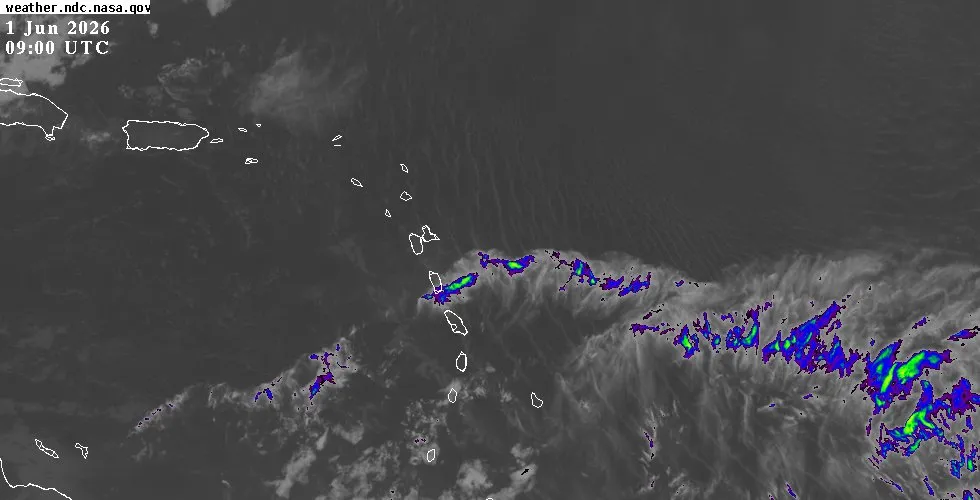
The Atlantic basin remains clear of organized tropical systems as the hurricane season begins. The National Hurricane Center is tracking three tropical waves currently positioned at different stages of their westward progression. An eastern Atlantic wave is near 30°W30°W south of 12°N, showing scattered moderate convection between 24°W and 37°W.
A central Caribbean wave is positioned near 72°W72°W south of 17°N with relatively limited convection due to dry air dominating the basin. A western Caribbean wave near 82°W82°W shows no organized deep convection at this time. All three waves are moving westward at 18 to 28 km/h10 to 15 mph.
The Saharan dust layer remains a dominant feature suppressing atmospheric instability, while moderate trade winds and wind shear conditions continue to inhibit tropical development across the basin. For detailed information on waves, pressure systems, and development potential, visit the outlook page.
With no active threats to the Eastern Caribbean, residents should use this relatively calm period to review hurricane preparedness plans and ensure supplies are in order as the season advances. For detailed conditions by island, check the weather page. The full forecast outlook and satellite imagery are available on the outlook page, and the interactive weather map provides live radar updates and detailed island-specific views.